Lugano 2026: the value of dialogue, from impossible to indispensable
In 2026 Switzerland took over the OSCE chairmanship, and Lugano has been proposed as the venue for the close of a year devoted to peace, trust and security.
There are words we use often without fully grasping what they mean. “Dialogue” is one of them. We use it when our position does not match someone else’s but we can see we are not far from common ground, forgetting that dialogue is at its most genuine precisely when the distance between two or more parties looks impossible to close.
“Dialogue” will have to be more than a word for Switzerland: it will have to be a guide. In 2026 the country took on the chairmanship of the Organization for Security and Co-operation in Europe for the third time, after holding the role in 1996 and in 2014. A prestigious appointment, but above all a considerable responsibility.
A responsibility because this is a very delicate historical moment, marked by the war in Ukraine, by deep geopolitical tensions and by the growing fragility of international relations.
Swiss diplomacy will be called on to bring closer what appears distant, to keep channels of communication open even when they seem closed, and to look for room for dialogue even where there seems to be none.
So in 2026 the OSCE chairmanship passed to Switzerland, with the role exercised by Federal Councillor Ignazio Cassis, a Ticinese doctor and politician, a member of the Federal Council since 2017 and head of the Federal Department of Foreign Affairs. In 2022 he served as President of the Swiss Confederation.
Faithful to the values of “dialogue” in presenting the Swiss programme, and aware that the principles on which European security was built have grown more fragile, Ignazio Cassis expressed his determination to look for and find room for dialogue even where conflicts appear most entrenched.
A narrow space, perhaps an uncertain one, through which the possibility of a truce, a de-escalation or a renewed exchange might pass. The OSCE has to watch, observe, verify, document and accompany every stage of a possible dialogue: an impartial presence and a point of reference.
The sense of Cassis’s whole mandate is held in one sentence meant to accompany the Swiss chairmanship: when diplomacy seems impossible, it becomes indispensable. That is not only a statement of principle. It is a declaration of responsibility, the manifesto of an organisation born to overcome and close distances.
The OSCE is the largest regional organisation devoted to security. It brings together 57 participating States across a geographical space reaching, in principle, from Vancouver to Vladivostok. Its history begins with the need to build dialogue between opposing worlds.
In 1975, at the height of the Cold War, a set of shared principles was defined in Helsinki as the basis for relations between States: respect for sovereignty, the inviolability of frontiers, territorial integrity, the renunciation of force, the peaceful settlement of disputes and the protection of fundamental rights. Fifty years on, with harmony gone even among European countries, those principles have lost none of their relevance.
For the OSCE, security is not only about armies, borders or the absence of war. It is also about the economy, the environment, the quality of democratic institutions, people’s freedom and respect for the law. Its work therefore develops across three dimensions: the politico-military, the economic and environmental, and the human.
These dimensions are a privileged vantage point on one and the same reality, and a way of being sure that no community can call itself genuinely secure when one of them fails.
Switzerland’s five priorities
The Swiss chairmanship will develop around five priorities converging on a single objective: rebuilding trust.
1) The Helsinki principles for a lasting peace
The first commitment concerns Ukraine. Switzerland will work to support a just and lasting peace, founded on international law and on the Helsinki principles, putting its own experience in mediation at the service of dialogue and security.
The OSCE will have to be ready to act quickly on the ground, preventing new escalation and contributing to the management and resolution of conflicts. Peace, seen this way, is not simply the end of armed fighting; it is the result of a path built on respect for the rules, for sovereignty and for people.
2) Keeping the exchange open
The OSCE is one of the few international platforms where Europe, the United States and Russia still sit at the same table. Which brings us back to “dialogue”: recognising differences and using them as the basis for a shared, constructive exchange.
Switzerland will support an inclusive multilateral diplomacy, encouraging cooperation on conflict prevention, arms control, the management of military risk and cyber security. Particular attention will go to cyberspace, where an incident, a misjudgement or an unexplained action can feed tensions that are hard to control.
Keeping channels of communication open does not automatically resolve conflicts, but it is the absence of dialogue that makes them more dangerous still.
3) Understanding the future before it arrives
Artificial intelligence, quantum computing and new digital technologies are changing the way we live, work and communicate.
They are also changing the very concept of security. The Swiss chairmanship will promote a governance of technology oriented towards human needs, building a stronger link between science and diplomacy. The focus will be on digital security, on water and energy resources and on the capacity to use innovation to prevent conflicts rather than feed them. Technology is a tool in the service of people; it is up to us to decide how to use it, to set the rules and to attach values to it.
4) Protecting democracy
There is no security without freedom. Switzerland will support democratic institutions, the protection of fundamental rights, field missions and the OSCE’s election observation work. The aim is to strengthen the capacity of democracies to face crises, supporting free and transparent elections, credible legislative processes and an independent judiciary. We have to defend democracy while recognising how fragile it is, because it is not a condition acquired once and for all. Democracy needs constant attention, active participation and continuous protection.
5) Making the OSCE able to act
The last priority concerns the Organisation itself. The OSCE remains indispensable, but it has to contend with political tensions, difficulties in decision-making and limited resources. Switzerland will work to preserve its fundamental instruments, from field missions to election observation, improving their effectiveness and securing their funding. The operations in the Western Balkans, in Moldova and in Central Asia will continue to perform an essential function: recognising tensions before they become crises, and intervening before a crisis turns into conflict.
A journey across Switzerland
During 2026 the chairmanship’s priorities will be explored through four international conferences: four cities, four meetings, four different perspectives. Lugano joins them in a different role.
St. Gallen: antisemitism, intolerance and discrimination will be discussed.
Geneva: the discussion will be devoted to emerging technologies and to the relationship between science and diplomacy.
Bern: will host a historical reflection on the birth of the OSCE.
Zug: cyber security, mediation and the prevention of escalation in cyberspace will be discussed.
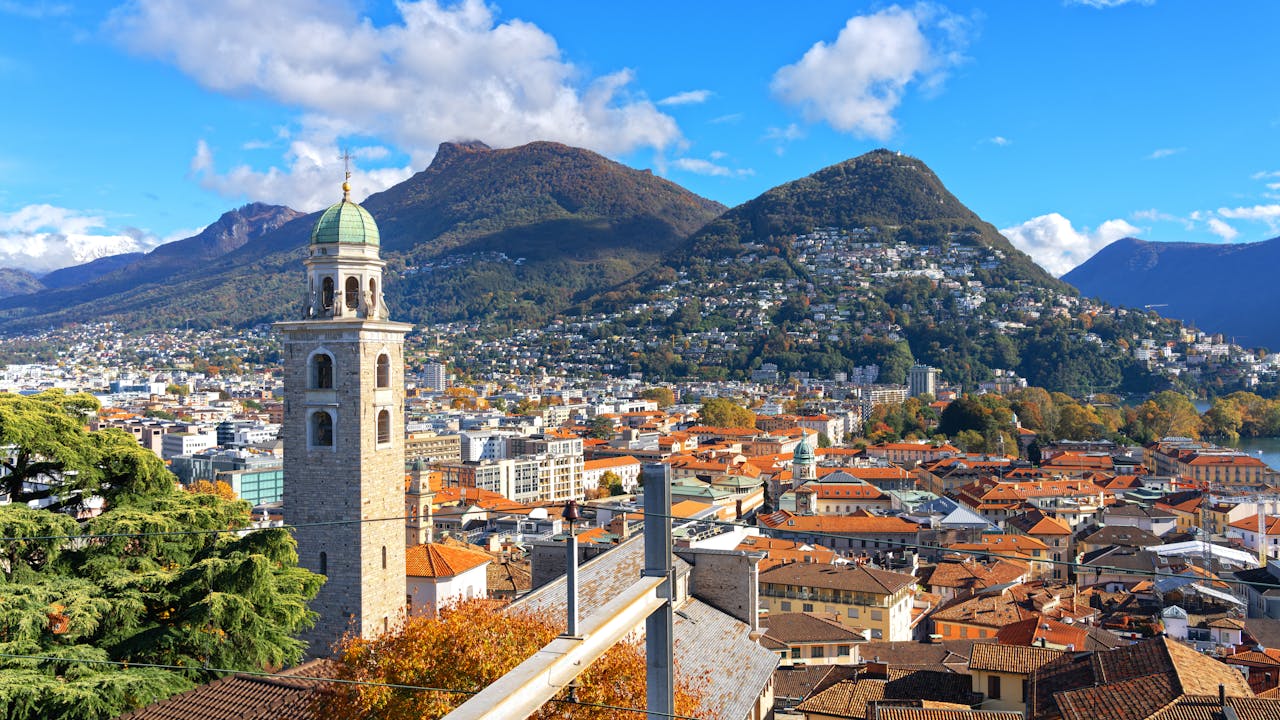
Lugano: has been proposed as the venue for the OSCE’s annual ministerial meeting.
Lugano, the place of meeting
On 3 and 4 December 2026 the city of Lugano is expected to host the OSCE’s annual ministerial meeting, and will welcome delegations, institutional representatives and leading figures in international diplomacy. It will be the most important political moment of the whole chairmanship: the occasion to consolidate the work done so far and to try to restore, through international cooperation, full dignity to the word “dialogue” and to the values attached to it.
But hosting does not only mean offering a space to meet in. It means creating the right conditions for people to recognise and listen to one another. It means turning a physical place into a place of relationship.
Lugano has always had that vocation. Different languages and cultures live here alongside one another without cancelling each other out, enriching one another in an exchange where everyone gains. Lugano will try to rebuild spaces of trust, to become the place of a difficult but necessary dialogue.
Sometimes the distance between two positions is measured not in kilometres but in willingness. And Lugano can become the right place for the will to talk again, to engage, to find each other alike through dialogue.